
Radar Is an Old Observation
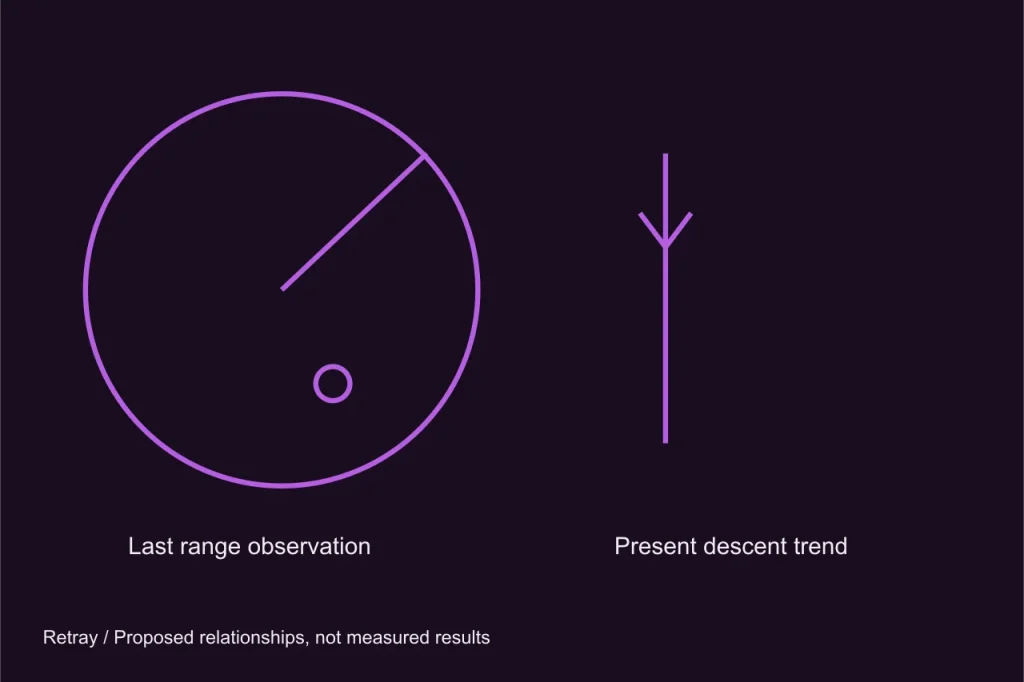
A radar dot looks authoritative. It occupies a precise position on a precise-looking display, even when the observation behind it is no longer current. Tin Horizon uses that gap as a central design question. The pilot should learn to combine the last range observation with a visible motion trend. The challenge is not to guess when the game will update a number. It is to understand what a known delay means for the next correction.
Show when the observation happened
The sweep itself can establish a clock. A return appears when the sweep passes its direction, then fades in a consistent way until the next observation. That fade must communicate age without making the point unreadable. A stable sweep marker or small age indicator can provide a second cue. We would avoid random flicker on the essential timing signal. Randomness may evoke old equipment, but it can also destroy the very relationship the player is supposed to learn. Imperfection needs a readable rule.
Pair distance with a trend
A range reading alone cannot describe whether the capsule is approaching slowly or accelerating toward the surface. A descent needle supplies another part of the picture. The two instruments should be close enough to compare without a long camera movement, while retaining distinct meanings. One reports an observation; the other helps estimate change. Their combined use lets the player form a rough prediction: by the next sweep, the ground should be this much closer if nothing changes. The design does not require mental arithmetic to exact decimal places.
Give the correction time to become evidence
After applying thrust, a pilot needs to recognise which reading can reveal the result first. If every display changes instantly and identically, the radar’s delay becomes decorative. If none responds for too long, the controls feel disconnected. The proposed arrangement lets the motion trend respond before the next range sample, so the player can see that the correction has begun without confusing that response with a fresh measurement of distance. This is an interface relationship to prototype, not a claim of physical simulation accuracy.
Make the window useful without making it complete
The crater shelf should offer large visual references: a rim, a boulder line and a change in surface angle. These help orient the approach but do not replace the instruments with an obvious target marker. At low altitude the window may make lateral drift easier to recognise than the range display does. At greater distance the radar may be more useful. Allowing different sources to matter at different moments encourages comparison instead of forcing the player to stare at one gauge throughout the flight.
Explain a late decision through the record
A replay could show the last sweep, the thrust input and the resulting descent trend along a shared timeline. It should distinguish information available at the time from information reconstructed afterwards. Otherwise the replay unfairly makes the player’s mistake look obvious. The landing sequence note discusses why the approach matters more than a single touchdown rating. A useful review identifies an assumption that can be changed on the next attempt, not merely a moment when the capsule crossed a hidden threshold.
What a first prototype should establish
One short descent with a fixed sweep period would be enough to begin examining the idea. The important questions are whether players notice the age of a return, whether they can describe the role of the descent needle and whether waiting for a new reading feels deliberate rather than passive. Adjustable visual timing cues could support different reading needs without changing the underlying relationship. These are proposed checks. We have not published results or promised a playable build. The broader flight concept remains available in the Flight Manuals.