
Landing Is a Sequence, Not a Score
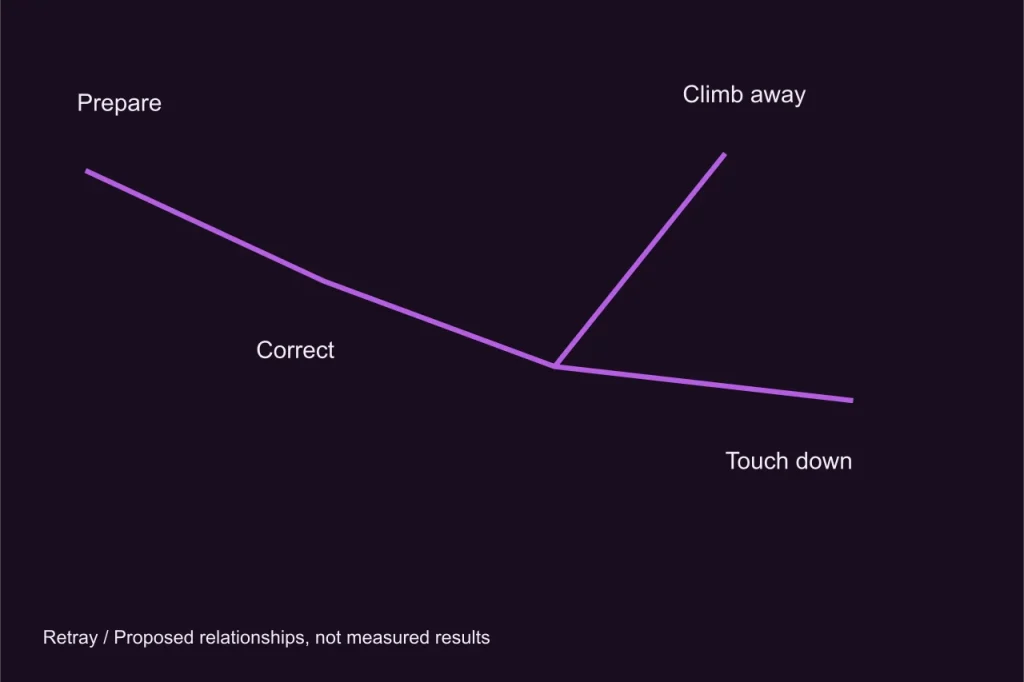
A soft touchdown can hide a poor approach that happened to end safely. A climb-away can reflect excellent judgement even though the lander never reaches the ground. A single score struggles to describe those differences. For Tin Horizon, we are interested in the sequence that produced the result: what the pilot observed, when a correction began and how much room remained to revise the plan. This is a design study of that sequence, not a scoring system announced for a finished game.
Preparation establishes the meaning of later evidence
The opening checks should create a baseline. If the radar reference is known and the thrust control has been exercised, later disagreement has a context. A player can ask whether the situation changed rather than wondering whether the interface ever worked. Preparation should therefore be short but meaningful. Repeating a long ritual before every attempt would make the learning loop tedious. Once the relationship is understood, the game could offer an abbreviated check that preserves the relevant information without requiring the same hand movements.
An approach has more than one margin
Vertical speed matters, but so do lateral movement, available thrust and the shape of the landing shelf. These margins should be visible through different sources. A capsule may be descending gently while drifting toward a boulder field. Another may be aligned well but have little reserve for a correction. The proposed design avoids reducing both situations to one traffic-light indicator. A warning can draw attention to a problem, but the cockpit and window should still allow the player to understand which margin is shrinking.
A correction changes the next question
Early in the approach, a small adjustment may preserve several options. Later, the same input may solve one problem while making another harder. This gives the flight a natural progression without demanding a scripted sequence. The pilot is repeatedly asking what action will leave a useful decision available at the next observation. The radar timing study is relevant here because a correction based on an old range sample can be sensible or reckless depending on the motion trend and remaining room.
Treat a retreat as a visible choice
A climb-away should be introduced before the player needs it. Its cost and limitations must be legible: it consumes reserve, changes the approach and may require another circuit of the crater. Calling it failure by default would encourage players to continue unsafe descents merely to avoid a negative label. We would instead distinguish a completed landing, an intentional recovery and a loss of control. The language of the result should describe what happened without pretending every outcome can be ranked on a single scale.
Review the information that was available
A proposed postflight strip would place observations and actions in order. It could show when a radar return was sampled, when thrust changed and when the shelf began to leave the window’s useful view. The strip should not reveal hidden information as if the pilot had ignored it. Reconstructed values can be useful, but they need a separate label. The purpose is to support a specific next experiment, such as correcting lateral drift earlier, rather than delivering a generic instruction to perform better.
Keep the first flight small enough to explain
One crater and one lander offer enough complexity for the initial concept. More locations would not help if the basic approach remains opaque. A useful prototype would ask players to describe one decision they would change and the evidence behind that choice. We have no published results for that experiment. The current work is a set of design proposals and concept images, with no release date announced. The Instrument Room explains why a recoverable, explainable flight is the foundation before a larger retro-space setting.