
Calibration Needs a Reference
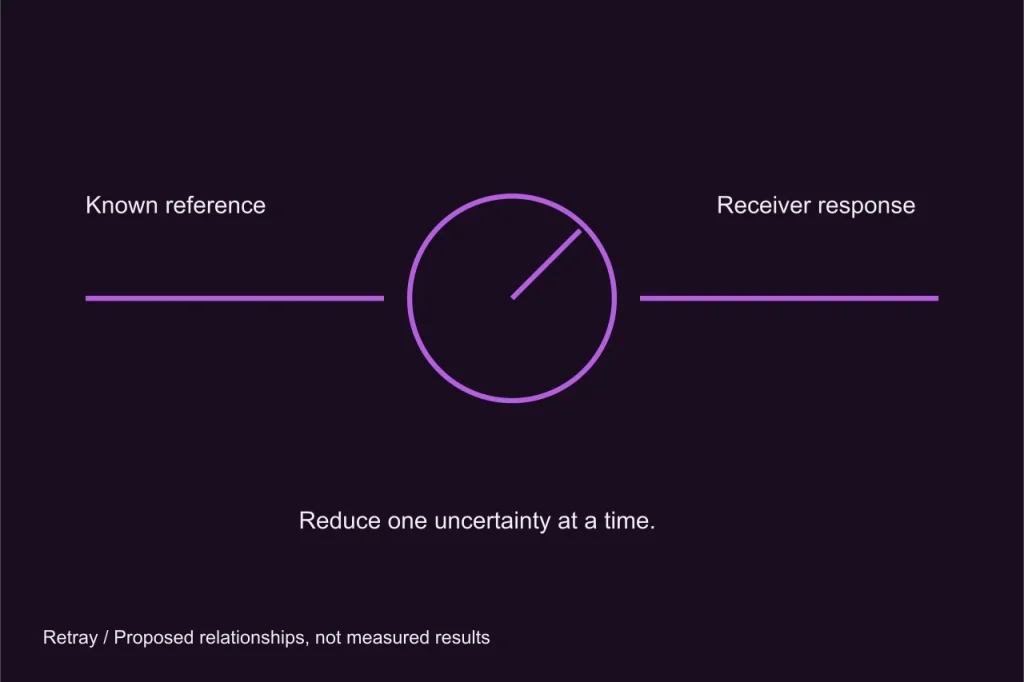
Turning a knob until a line turns green can look like calibration without asking the player to understand anything. In Relay Return, the proposed task is more specific: compare an uncertain response with a reference whose purpose is known, adjust one relationship and check whether the result supports the next action. Calibration should reduce a defined uncertainty. It should not magically declare an entire damaged spacecraft healthy.
Name the thing being compared
A receiver can be loud, correctly tuned and still listening to an outdated message. These are different properties. The calibration procedure should identify which one it addresses. A local reference oscillator might establish the receiver’s response around a known frequency, but it cannot prove that a distant station is sending current instructions. Keeping that boundary explicit prevents a successful check from becoming a misleading all-clear. The cockpit manual can state the purpose in a short sentence beside the control rather than burying it in a separate tutorial.
A reference needs a reason to be trusted
The reference cannot simply be another mysterious gauge. Its behaviour should be established in a calm context, perhaps by comparing two known selector positions with an unmistakable change in the test pulse. The player then understands what remains stable while the receiver adjustment changes. If the reference itself can fail later, that should be a separate, inspectable problem. Introducing simultaneous uncertainty in every component would make the task depend on guessing rather than reasoning from evidence.
Bound the adjustment
A rotary control should communicate its range and current position. A coarse range selector followed by a fine adjustment offers two distinct decisions, but only if both have clear feedback. The player should not need to sweep an invisible range endlessly in search of a tiny valid point. Broad response regions can support understanding, with a narrower preferred region offering refinement. Keyboard increments and controller input should reach the same useful positions without demanding motor precision unrelated to the intended problem.
Separate local success from mission confidence
Once the receiver responds correctly to the local reference, the pilot can return to the distant signal with one uncertainty reduced. The message may still be weak or old. This creates a meaningful sequence: check the instrument, observe the signal and decide whether another observation is needed. The switch-state note describes the same discipline at a smaller scale. A requested state, a confirmed response and the conclusion drawn from that response are connected, but they are not interchangeable.
Make a poor adjustment recoverable
An adjustment can move the system farther from its reference without making the whole mission unrecoverable. A marked starting position or a reset to the last known setting gives the player a way to compare experiments. The reset should not erase the cost of repeated transmissions or imply that time has reversed. It restores one control relationship. This distinction keeps experimentation useful while preserving the broader resource decisions of the flight. A player should know what a reset does before relying on it in an uncertain situation.
Record the conclusion honestly
The proposed signal log would distinguish checked locally, observed remotely and still uncertain. It should not automatically convert a partial check into a confident navigation instruction. That vocabulary can also guide the site’s design writing: a concept is not a tested result, and a diagram is not evidence of a working simulation. No calibration prototype results are claimed here. The next useful step would be a small interaction that asks whether a player can explain both the value and the limit of the completed check. For the full return scenario, begin with the Flight Manuals.