
A Switch Needs a Visible State
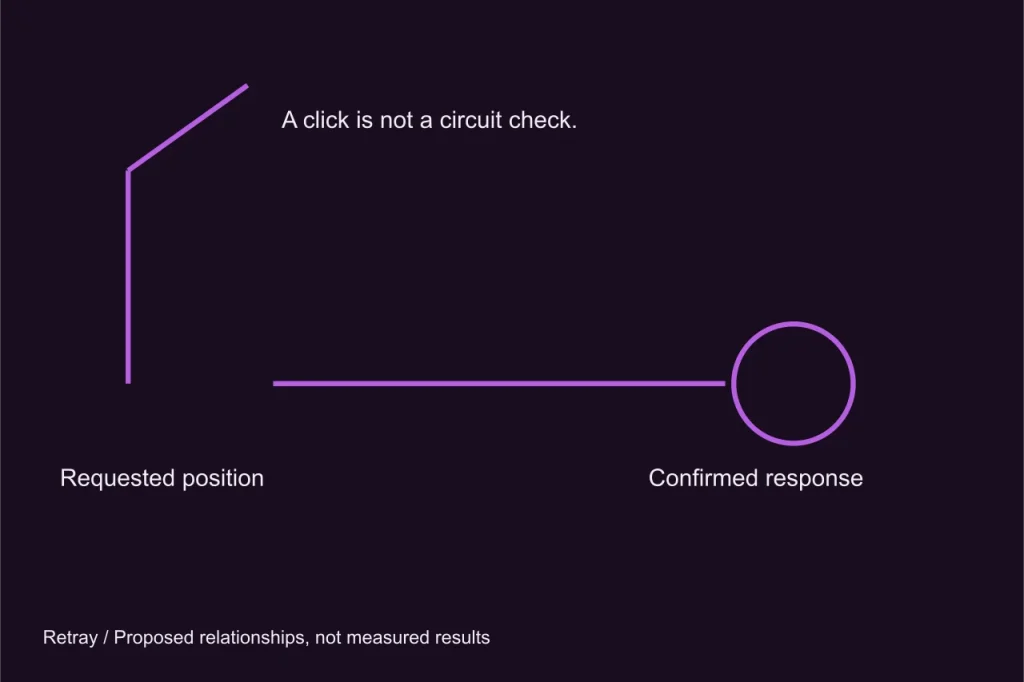
A physical toggle can make an action feel certain even when the connected machine has not responded. That difference is useful material for an analog spacecraft game, but only if the cockpit makes it readable. In Relay Return, selecting the receiver bus should not instantly guarantee a reliable signal. The switch expresses a request. A lamp, a needle or a separate test gives evidence of the result. This note explores that separation as a design proposal, not a report of completed testing.
Start with three states
The simplest useful model distinguishes the control position, the circuit condition and the pilot’s current knowledge. A switch can be on while its circuit is unpowered. The circuit can be powered while the pilot has not yet checked the relevant indication. Collapsing these into one glowing button removes the opportunity to reason about a fault. Separating them without explanation creates confusion. The panel therefore needs a clear relationship between the control and its confirmation, established during a calm opening task before any urgent situation depends on it.
Let placement do some of the teaching
A confirmation lamp belongs close enough to its control that the relationship can be discovered, but not so close that the two appear to be one object. A short printed circuit line can connect them. Repeated spacing can distinguish a control row from a response row. The same visual grammar should continue across the panel, including less dramatic functions. If one lamp means requested and another means achieved, their shapes or labels must explain the difference; colour alone is insufficient, especially in a cockpit already filled with tinted light.
A click confirms the hand, not the machine
The proposed sound of a toggle should confirm that the input was accepted. It must not imply that a distant relay has completed its operation. A second sound could identify that event, but its visual equivalent remains necessary. Otherwise players who lower the volume lose information rather than atmosphere. The same distinction applies to animation. A lever can finish moving before a circuit settles. The delay should be purposeful and bounded, with a visible waiting state rather than an unexplained pause that resembles a missed input.
Make a fault inspectable
Suppose the receiver lamp stays dark after the pilot changes the selector. A useful next action is to inspect the supply indication or run a short lamp check. Those options test different hypotheses. A bad design simply asks the player to flip the switch again until a scripted success occurs. We want the cockpit to support a chain of observations in which each action narrows the problem. The calibration study considers a related requirement: a check needs a known reference if it is to establish anything useful.
Avoid accidental puzzles in ordinary use
Not every switch deserves uncertainty. Routine controls should behave consistently enough that players can build confidence in the system. Faults become interesting against that baseline. If every operation carries an arbitrary chance of failure, careful observation stops feeling worthwhile. The proposed prototype would begin with one reliable circuit and one deliberately inspectable fault. It would ask whether a player can explain the discrepancy without being told which component is wrong. No success rate is claimed here; this is the question the prototype would need to answer.
Preserve the relationship across input methods
Mouse, keyboard and controller interactions should reach the same requested state and expose the same confirmation. Holding a key should not repeatedly cycle a guarded switch by accident. Focus needs to remain visible when the cockpit camera moves. A textual instrument view could offer the same relationships without requiring precise pointer placement. These choices matter because the intended difficulty lies in interpreting the machine, not in fighting its controls. The Instrument Room places that responsibility at the centre of Retray’s design method.